


Each bulking and reducing have professionals and cons.
For those who’re making an attempt to resolve which you need to do, the reply relies upon primarily in your physique fats, coaching expertise, and targets.
Bulking provides each lean mass (yay) and physique fats (boo), and reducing unveils your abs (hooray) however stunts muscle development (hiss).
And it’s this dilemma that makes for a health purgatory of types the place you don’t actually commit to at least one technique or one other and thus stagnate when it comes to progress.
On this article, you’ll be taught precisely when you need to bulk, when you need to lower, and when neither is the appropriate selection.
Key Takeaways
- Whether or not you need to bulk or lower relies upon primarily in your physique fats, coaching expertise, and first aim (construct muscle vs. lose fats).
- Bulk in case you’re comparatively lean and need to maximize muscle and energy achieve; lower in case you’re carrying extra physique fats and need to get leaner.
- For those who’re new to weightlifting, you’ll be able to typically construct muscle and lose fats on the identical time by consuming at upkeep or in a small calorie deficit.
- For those who’re within the center (not very lean, not very excessive physique fats), both strategy works—so select the one you’re most motivated to stay with.
- You don’t all the time have to bulk or lower—upkeep is a sound choice while you need to maintain your progress and take a break from weight-reduction plan.
Ought to You Bulk or Reduce?
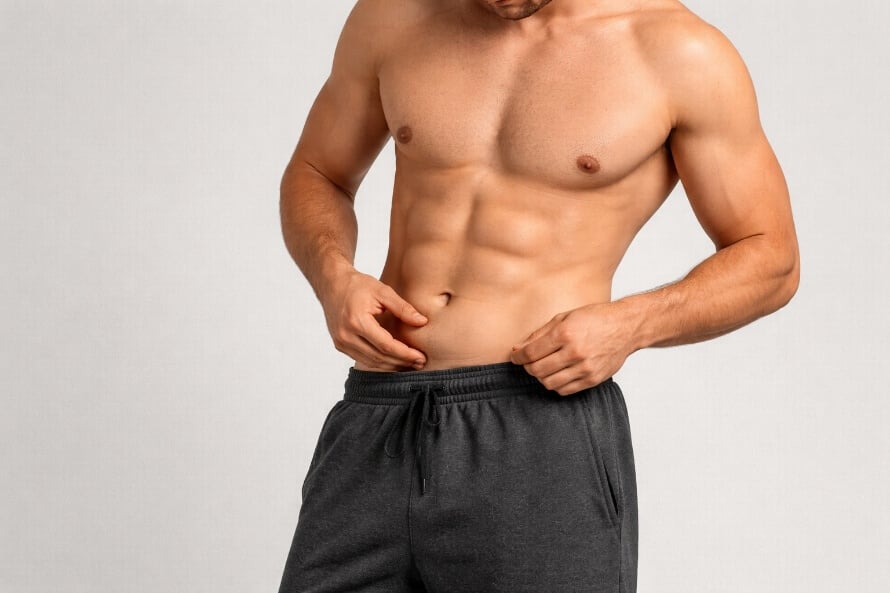
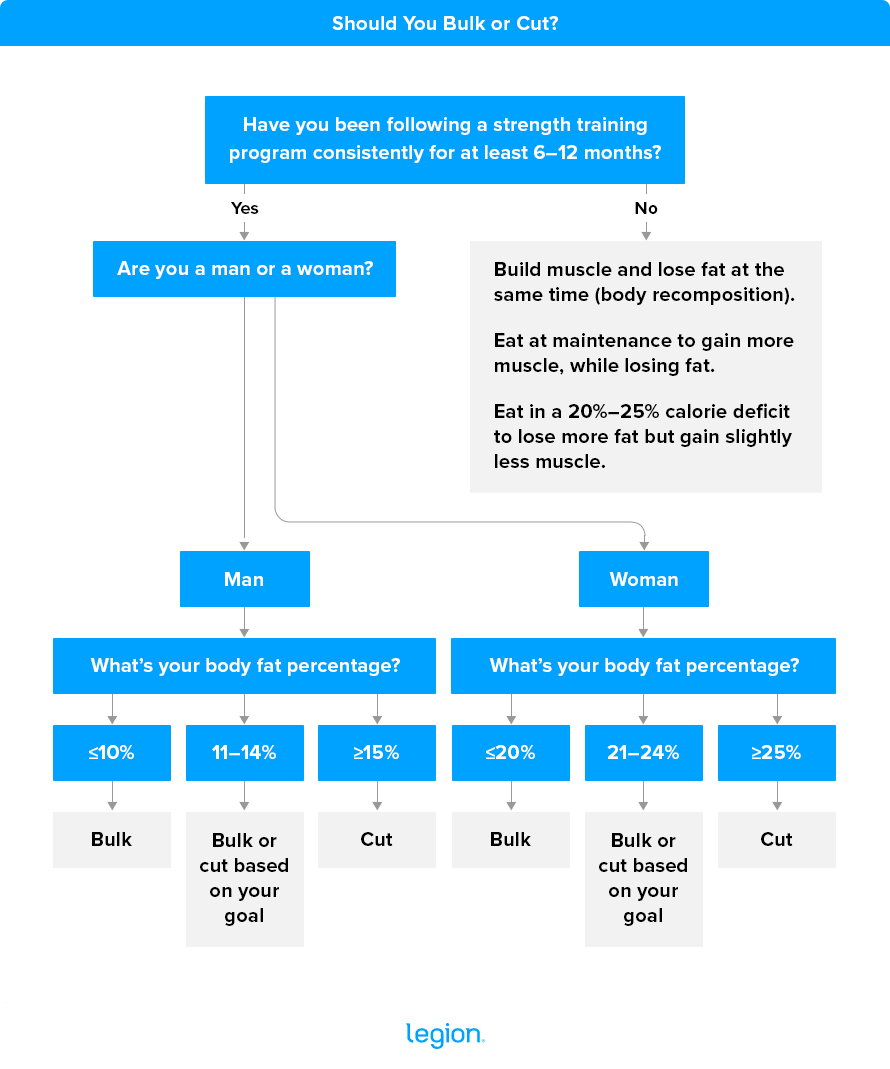
If you wish to achieve muscle and energy as rapidly as attainable, and are at or under 10% body fat (males) or 20% (girls), you should bulk.
If you wish to lose fats as rapidly as attainable, and are at or above 15% physique fats (males) or 25% (girls), you should cut.
For those who fall between these ranges, both strategy can work. On this case, do the one which motivates you most: in case you’re extra excited to construct muscle, bulk; in case you’re extra motivated to get leaner, lower.
The one exception is in case you’ve been coaching for lower than 6–12 months. In that case, you’ll be able to often construct muscle and lose fats on the identical time, also known as physique recomposition or “recomping.” You are able to do this by consuming at upkeep or in a calorie deficit.
For those who eat at upkeep, you’ll often achieve extra muscle whereas nonetheless shedding fats. For those who eat in a calorie deficit, you’ll often achieve barely much less muscle however lose barely extra fats.
If you wish to be walked by means of this step-by-step, right here’s a flowchart to assist:
Can You Recomp As a substitute of Bulking or Reducing?
Sure—however solely in sure conditions. For those who’re new to weightlifting or returning after an extended layoff, your physique is so delicate to strength training which you could construct muscle and lose fats on the identical time. This is named physique recomposition.
You are able to do this by consuming at upkeep to maximise muscle achieve whereas nonetheless shedding fats, or by consuming in a 20–25% calorie deficit if fats loss is your prime precedence (although this can scale back how a lot muscle you achieve).
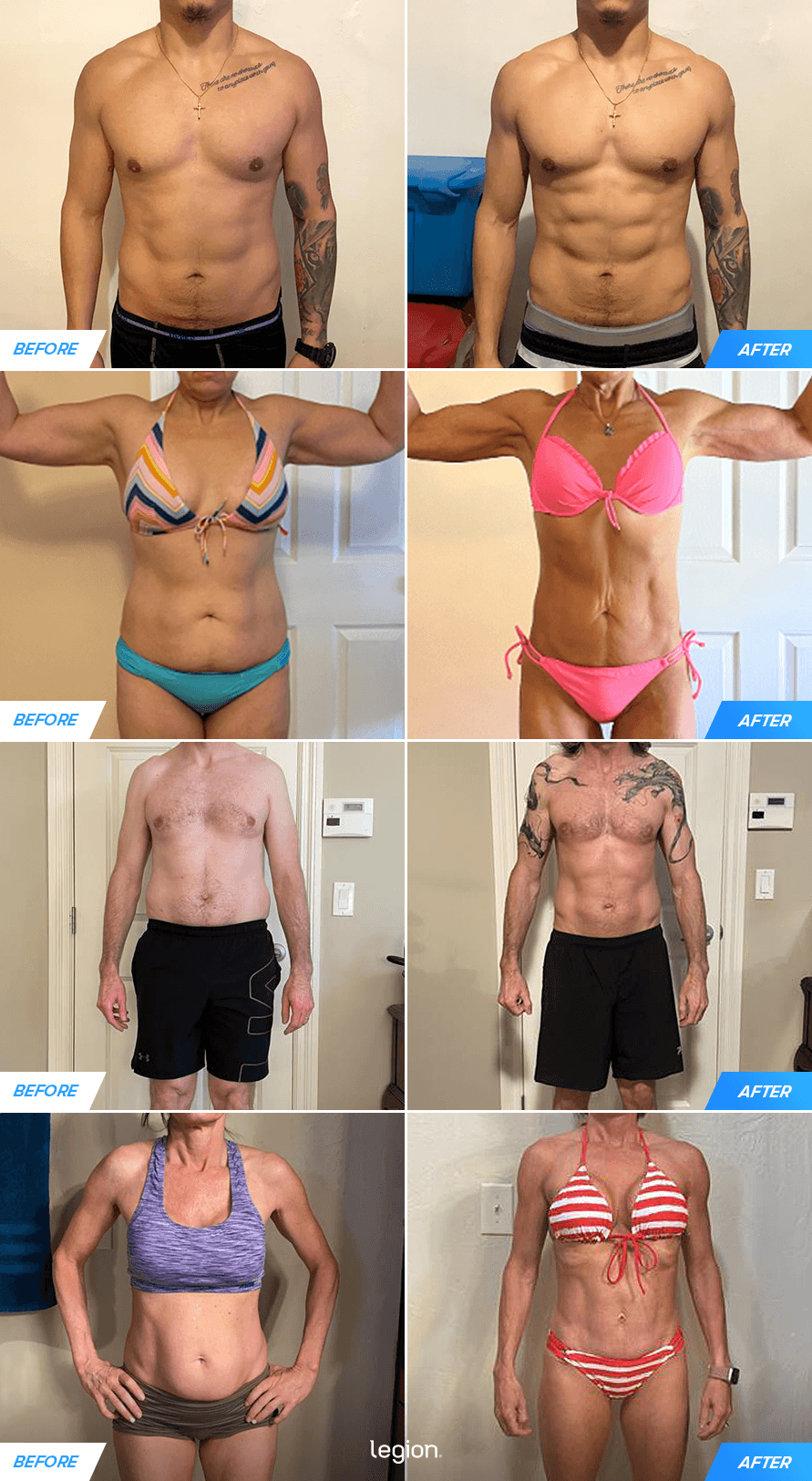
With the appropriate coaching and vitamin plan, this strategy can produce dramatic modifications in physique composition—even and not using a devoted bulk or lower. For instance, listed here are outcomes from individuals who used this strategy with Legion’s body transformation coaching program:
However, in case you’ve been coaching constantly for greater than 6–12 months, you’ll make higher progress by selecting a devoted section—both bulking or reducing.
To be taught extra about precisely how one can efficiently “recomp,” try this text:
The Secret to Body Recomposition: Lose Fat & Gain Muscle
Ought to You Bulk or Reduce if You’re Skinny Fats?
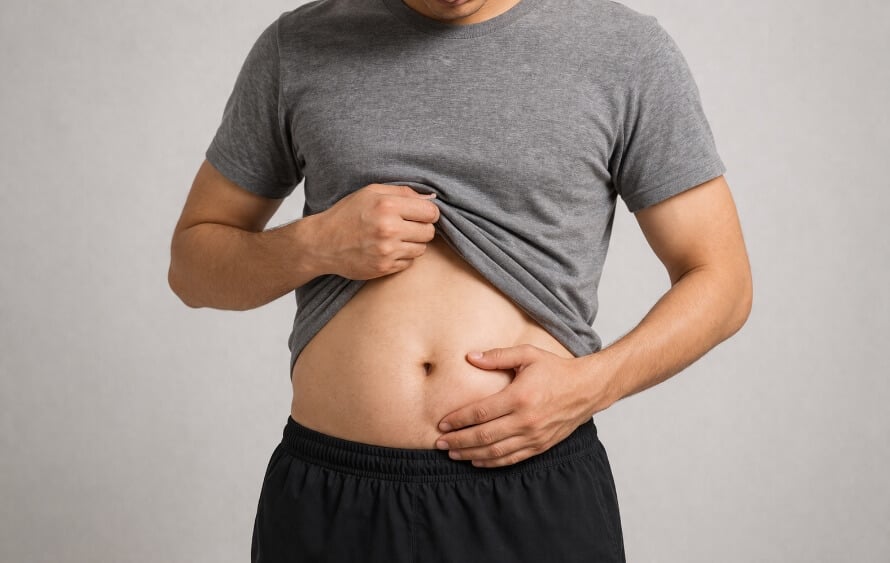
For those who’re “skinny fats” (comparatively excessive physique fats and low muscle mass), what you need to do relies upon primarily in your coaching expertise.
For those who’re new to weightlifting, you’ll be able to often construct muscle and lose fats on the identical time. On this case, eat in a 20–25% calorie deficit to speed up fats loss whereas nonetheless gaining muscle.
For those who’re extra skilled, you’ll make higher progress by specializing in one aim at a time. Most individuals on this place are higher off beginning with a small calorie surplus (round 10%) to construct a strong base of muscle, then reducing later to cut back physique fats.
If you’d like a extra detailed, step-by-step plan, see our full information to eliminating the “skinny fats” look:
Skinny Fat: What It Is, What Causes It, and How to Fix It
How Lengthy Ought to a Bulk or Reduce Final?
How lengthy you spend bulking and reducing relies on the next:
- How a lot weight you need to achieve or lose: If you wish to achieve a whole lot of muscle, you’ll want to remain in a surplus for longer than somebody who solely needs so as to add just a few kilos of muscle to their body.
Likewise, when you have a whole lot of fats to lose, you’ll want to remain in a deficit longer than somebody who’s solely seeking to drop one or two physique fats proportion factors.
- What number of years you’ve been coaching: The extra skilled you’re, the longer it takes to construct muscle, and thus the longer it’s important to spend in a surplus to realize lean mass.
That stated, a great rule of thumb is to spend not less than 8–12 weeks bulking and use a bulking–reducing ratio of three:1 (except you’re very obese, wherein case you might have to spend significantly extra time reducing than bulking till you attain a extra wholesome weight).
For instance, in case you spend 12 weeks bulking, you need to spend the next 4 weeks reducing.
Be mindful, although, that none of those figures are etched in stone and can seemingly change as you develop into extra skilled with bulking and reducing.
When you’re good at controlling your calorie consumption and may simply keep a wholesome physique fats proportion, you might favor to shorten your cycles of reducing and bulking utilizing mini cuts and bulks.
When Ought to You Swap From Bulking to Reducing?
You need to change from bulking to reducing while you’ve gained as a lot muscle as you need for now or your physique fats has risen to the purpose the place you’re now not snug with the way you look.

For most individuals, this implies ending a bulk round 15% physique fats (males) or 25% (girls), then reducing till you’re lean once more.
Beginning your bulks lean means that you can spend extra time in a calorie surplus, which implies extra time gaining muscle. It additionally retains your cuts shorter and simpler, since you could have much less fats to lose to return to your most popular degree of leanness.
For those who’re uncertain the place you stand, use the flowchart above to resolve whether or not it’s time to change phases.
Do You All the time Must Be Bulking or Reducing?
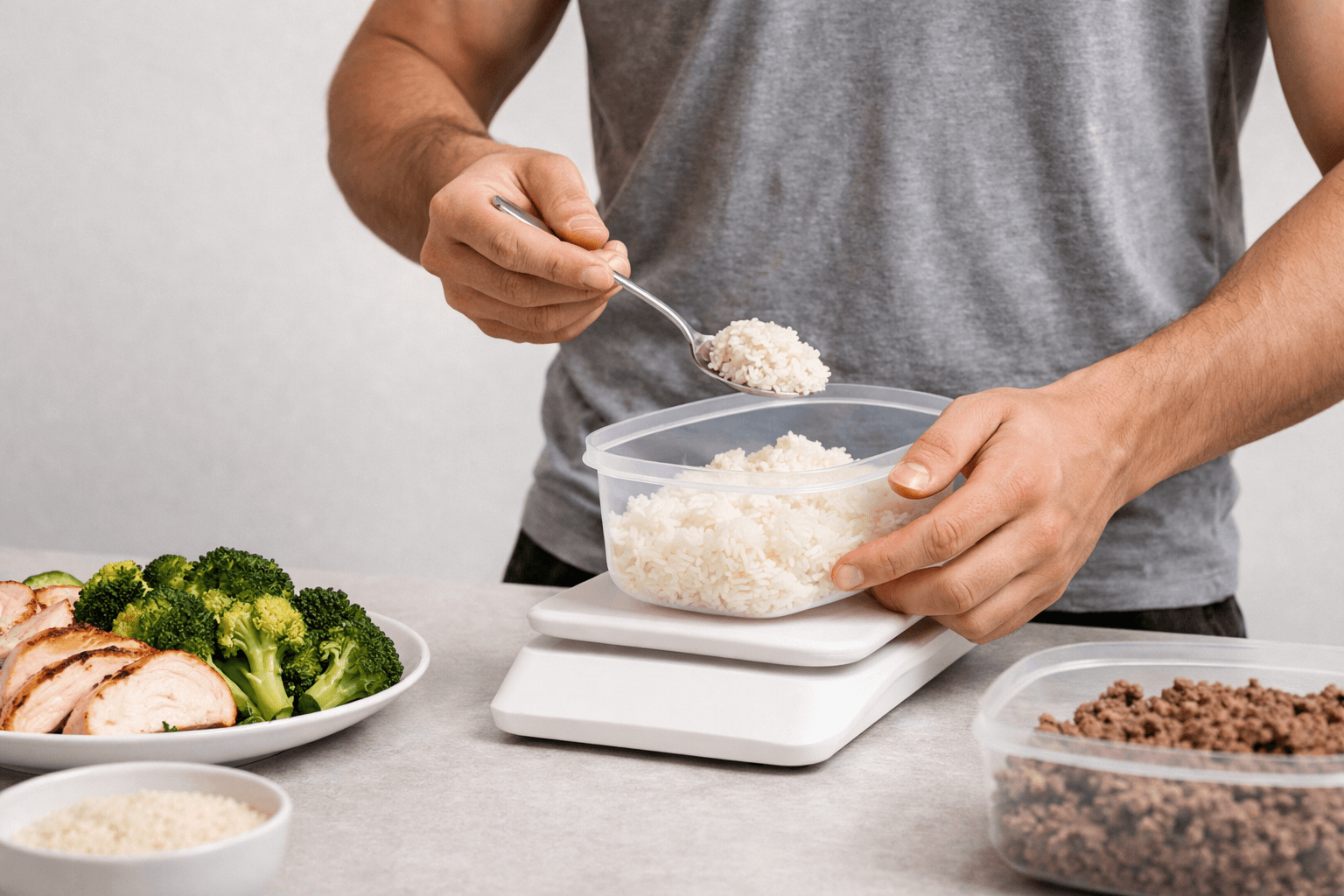
No. You don’t all the time should be in a calorie surplus or deficit. In lots of instances, sustaining your weight is the most suitable choice—particularly in case you’re completely happy along with your present physique composition, desire a break from weight-reduction plan, or favor an easier, lower-effort strategy to consuming.
At upkeep, you received’t achieve important muscle or lose important fats. As a substitute, you’ll largely maintain your progress till you resolve to decide to your subsequent bulk or lower.
READ MORE: What Is Maingaining? Does It Work for Building Muscle?
The Backside Line on Bulk vs. Reduce
Whether or not you need to bulk or lower relies upon primarily in your physique fats, coaching expertise, and targets.
For those who’re lean and need to construct muscle as rapidly as attainable, bulk. For those who’re carrying extra physique fats and need to get leaner, lower. For those who’re new to coaching, you’ll be able to typically construct muscle and lose fats on the identical time, however this turns into a lot more durable as you achieve expertise.
For those who fall someplace within the center, both strategy can work—so select the one which retains you motivated and constant.
And keep in mind: you don’t all the time should be bulking or reducing. Upkeep is a sound choice while you need to maintain your progress and take a break earlier than committing to your subsequent section.
FAQ #1: How do you narrow with out shedding muscle?
To chop with out shedding muscle, you should use a average calorie deficit, eat sufficient protein, and proceed lifting heavy weights.
1. Use an aggressive calorie deficit.
Set your calorie deficit at 20–25% (eat 20–25% fewer energy than you burn daily). This is sufficient to lose fats lickety-split with out shedding muscle or wrestling with extreme starvation, lethargy, and the opposite hobgoblins of low-calorie weight-reduction plan.
(And in case you’d like much more particular recommendation about what number of energy, how a lot of every macronutrient, and which meals you need to eat to succeed in your targets, take the Legion Diet Quiz.)
READ MORE: How Many Calories Should I Eat?
2. Eat a high-protein food regimen.
To lose fats as rapidly as attainable, goal to eat 1–1.2 grams of protein per pound of physique weight day by day.
And in case you’re very obese (25%+ physique fats in males and 30%+ in girls), this may be lowered to round 40% of your whole day by day energy.
READ MORE: How Much Protein Do I Need? The Definitive (and Science-Based) Answer
3. Do a whole lot of heavy compound weightlifting.
Lifting weights helps you maintain muscle and lose fat. To maximise these advantages, do the next:
4. Do a average quantity of cardio.
One of the best ways to incorporate cardio in a weight reduction routine is to do as little as wanted to succeed in your required charge of weight reduction and keep match and completely happy, and no extra.
Right here’s what usually works finest:
- Do not less than two low- to moderate-intensity cardio exercises per week of 20–60 minutes every.
- Do one HIIT exercise weekly in case you get pleasure from it.
- Restrict whole cardio to 2–3 hours weekly.
- Do your cardio and weightlifting on separate days if attainable, and if it’s important to do them on the identical day, elevate weights first and attempt to separate the 2 exercises by not less than 6 hours.
5. Take the appropriate dietary supplements.
You don’t want dietary supplements to lose fats, however the appropriate ones could make the method quicker and extra snug:
- Caffeine: 3–6 mg of caffeine per kilogram of physique weight per day will increase metabolic charge and helps you practice more durable whereas weight-reduction plan.
- Yohimbine: 0.1–0.2 milligrams of yohimbine per kilogram of physique weight earlier than fasted coaching enhances fats loss.
- Fats Burner: Efficient fat burners include components that enhance the variety of energy you burn and scale back starvation and cravings, making weight reduction extra simple.
And in case you’d wish to know precisely what different dietary supplements you need to take to succeed in any and all your health targets, take the Legion Supplement Finder Quiz.
FAQ #2: How do you achieve muscle with out getting fats?
To realize muscle with out getting fats, eat a small calorie surplus, prioritize protein, and concentrate on progressive energy coaching.
1. Eat barely extra energy than you burn.
Research exhibits that the candy spot for maximizing muscle achieve whereas minimizing fats achieve is someplace round 105–110% of your whole day by day vitality expenditure (TDEE). Eating greater than this received’t allow you to construct muscle quicker, it’ll solely trigger you to realize extra fats.
2. Eat the appropriate stability of macros.
Right here’s what works for most individuals:
- Protein: Consuming 0.8–1 gram of protein per pound of physique weight per day is sufficient to maximize muscle development. That stated, consuming extra (1.5–2 grams per pound) may help reduce fats achieve. This often works out to round 20–30% of energy for most individuals.
- Fats: Getting 20–% of your energy from fats is sufficient to optimize well being and add taste to your meals whereas leaving loads of room for protein and carbs.
- Carbs: Get the remainder of your energy (~40–60%) from carbs.
(Once more, in case you really feel confused about what number of energy, how a lot of every macronutrient, and which meals you need to eat to succeed in your targets, take the Legion Diet Quiz to be taught precisely what food regimen is best for you.)
3. Don’t eat an excessive amount of.
Gorging a few days per week will allow you to bulk up quick, however you’ll achieve fats at double and even triple the traditional charge.
Don’t do that. As a substitute, be taught how to “cheat” intelligently and management your energy whereas bulking the identical approach you’ll whereas reducing.
4. Emphasize compound weightlifting and progressive overload.
To maximise the muscle- and strength-building results of weightlifting, do the next:
- Carry weights 3–5 instances weekly
- Prioritize compound workouts
- Practice with 75–85% of your one-rep max
- Give attention to progressive overload
5. Take the appropriate dietary supplements.
The perfect dietary supplements for supporting muscle development are:
- Protein powder: Consuming sufficient protein is crucial for constructing muscle. Protein powders like Whey+, Casein+, and Egg+ make hitting your goal simpler.
- Creatine: Creatine boosts muscle and energy achieve, improves endurance, and reduces muscle harm and soreness. For a pure supply of creatine, attempt Legion’s creatine monohydrate powder, creatine gummies, creatine capsules, or post-workout Recharge.
- Pre-workout: A high quality pre-workout helps you practice more durable by boosting vitality, focus, and athletic efficiency. Legion’s Pulse is obtainable with or without caffeine.
FAQ #3: Can I lower and bulk on the identical time?
No. Physiologically talking, fats loss and muscle development have “irreconcilable variations.” Their mutual incompatibility stems from their relationship to the physique’s energy balance.
That stated, it’s attainable to construct muscle and lose fats concurrently—or obtain physique recomposition—while you’re new to weightlifting.
In your first yr of weightlifting alone you’ll be able to expect to gain wherever from 15–25 kilos of muscle as a man and about half that as a girl, a phenomenon referred to as “beginner features.”
And usually, you’ll be able to pull this off whereas gaining little or no physique fats and even shedding fats—thus reaching “recomp.”
As soon as the honeymoon section is over, although, your aim will probably be to lose fats and never muscle whereas in a calorie deficit and to realize muscle with minimal fats whereas in a calorie surplus.
FAQ #4: How do I transition from a lower to a bulk?
To transition from a lower to a bulk, improve your energy to a upkeep degree for just a few weeks earlier than shifting right into a surplus.
This isn’t to repair “metabolic harm” brought on by weight-reduction plan—weight-reduction plan doesn’t hurt your metabolism. Whereas your metabolism can sluggish whereas weight-reduction plan, that is regular and rapidly reverses when you begin consuming extra.
The actual cause for a upkeep interval between reducing and lean bulking is to keep away from overeating, which may result in undesirable fats achieve. After weight-reduction plan and shedding physique fats, starvation and cravings can improve, particularly in case you’re very lean. This, mixed with a sudden improve in meals consumption, can result in overeating.
By transitioning from reducing to upkeep for just a few weeks earlier than lean gaining, you’ll be able to management your urge for food higher and keep your new physique composition, setting your self up for a profitable muscle-building section.
FAQ #5: When ought to I cease bulking?
Cease bulking while you’ve gained sufficient muscle otherwise you’re now not completely happy along with your physique fats proportion (as a result of it’s too excessive). Whereas these factors are totally different for everybody, males usually cease bulking once they exceed 15% physique fats, and girls may achieve this once they attain 25% physique fats.
FAQ #6: Ought to I bulk or lower first?
It relies on how a lot physique fats you could have and your coaching expertise, however most individuals ought to lower in the event that they’re comparatively excessive in physique fats and bulk in the event that they’re already lean.
For those who’ve been coaching for greater than 6 to 12 months, a great rule of thumb is to bulk in case you’re at or under about 10% physique fats (males) or 20% (girls), and lower in case you’re at or above about 15% (males) or 25% (girls).
For those who’re new to weightlifting, you’ll be able to typically construct muscle and lose fats on the identical time, so you might not want to decide on between bulking and reducing straight away.
FAQ #7: How lengthy ought to a 20-pound bulk take?
For most individuals, gaining 20 kilos throughout a bulk takes a number of months to a yr, relying in your coaching expertise and the way rapidly you achieve weight.
A great rule of thumb is to realize about 1–2% of your physique weight monthly in case you’re a newbie, and about 0.5–1% monthly in case you’re extra skilled.
For instance, a 170-pound one that has been coaching for a few years ought to goal to realize about 0.8–1.7 kilos monthly, which implies gaining 20 kilos would seemingly take round 12–24 months.
Gaining weight quicker than this often results in extra fats achieve, whereas staying inside these ranges helps be sure that many of the weight you achieve is muscle.
Need Extra Content material Like This?
Try these articles:
Scientific References +
- Farinatti, Paulo TV, and Antonio G Castinheiras Neto. “The Effect of Between-Set Rest Intervals on the Oxygen Uptake during and after Resistance Exercise Sessions Performed with Large- and Small-Muscle Mass.” Journal of Strength and Conditioning Research, vol. 25, no. 11, Nov. 2011, pp. 3181–3190, https://doi.org/10.1519/jsc.0b013e318212e415.
- MARX, JAMES O., et al. “Low-Volume Circuit versus High-Volume Periodized Resistance Training in Women.” Medicine and Science in Sports and Exercise, Apr. 2001, pp. 635–643, https://doi.org/10.1097/00005768-200104000-00019.
- Iraki, Juma, et al. “Nutrition Recommendations for Bodybuilders in the Off-Season: A Narrative Review.” Sports, vol. 7, no. 7, 26 June 2019, p. 154, www.ncbi.nlm.nih.gov/pmc/articles/PMC6680710/, https://doi.org/10.3390/sports7070154.
- Forbes, Gilbert B., et al. “Deliberate Overfeeding in Women and Men: Energy Cost and Composition of the Weight Gain*.” British Journal of Nutrition, vol. 56, no. 1, 1 July 1986, pp. 1–9, www.cambridge.org/core/journals/british-journal-of-nutrition/article/deliberate-overfeeding-in-women-and-men-energy-cost-and-composition-of-the-weight-gain/F44C5604D2D6FFF636374D722CB3995F, https://doi.org/10.1079/BJN19860080.
- Antonio, Jose, et al. “The Effects of Consuming a High Protein Diet (4.4 G/Kg/D) on Body Composition in Resistance-Trained Individuals.” Journal of the International Society of Sports Nutrition, vol. 11, no. 1, 12 May 2014, https://doi.org/10.1186/1550-2783-11-19.
- Antonio, Jose, et al. “A High Protein Diet (3.4 G/Kg/D) Combined with a Heavy Resistance Training Program Improves Body Composition in Healthy Trained Men and Women – a Follow-up Investigation.” Journal of the International Society of Sports Nutrition, vol. 12, no. 1, 20 Oct. 2015, https://doi.org/10.1186/s12970-015-0100-0.
- Eckerson, Joan M., et al. “Effect of Creatine Phosphate Supplementation on Anaerobic Working Capacity and Body Weight after Two and Six Days of Loading in Men and Women.” The Journal of Strength and Conditioning Research, vol. 19, no. 4, 2005, p. 756, https://doi.org/10.1519/r-16924.1.
- Bassit, Reinaldo Abunasser, et al. “Effect of Short-Term Creatine Supplementation on Markers of Skeletal Muscle Damage after Strenuous Contractile Activity.” European Journal of Applied Physiology, vol. 108, no. 5, 3 Dec. 2009, pp. 945–955, https://doi.org/10.1007/s00421-009-1305-1.